November 2026 saw one of the year's most important events for discussions on transformative change in the domains of biodiversity and climate change, the Nature-based Solutions (NbS) International Congress. The forum was the product of combined efforts from the French National Research Program on NbS (SOLU-BIOD) and NetworkNature, with the collaboration of UNP+, Biodiversa+, Sorbonne University and the City of Paris. In the words of the organisers, the Congress was envisioned as a "meeting point for those working around nature and people", including international and local actors alike from scientific, governmental, corporate and civil circles.
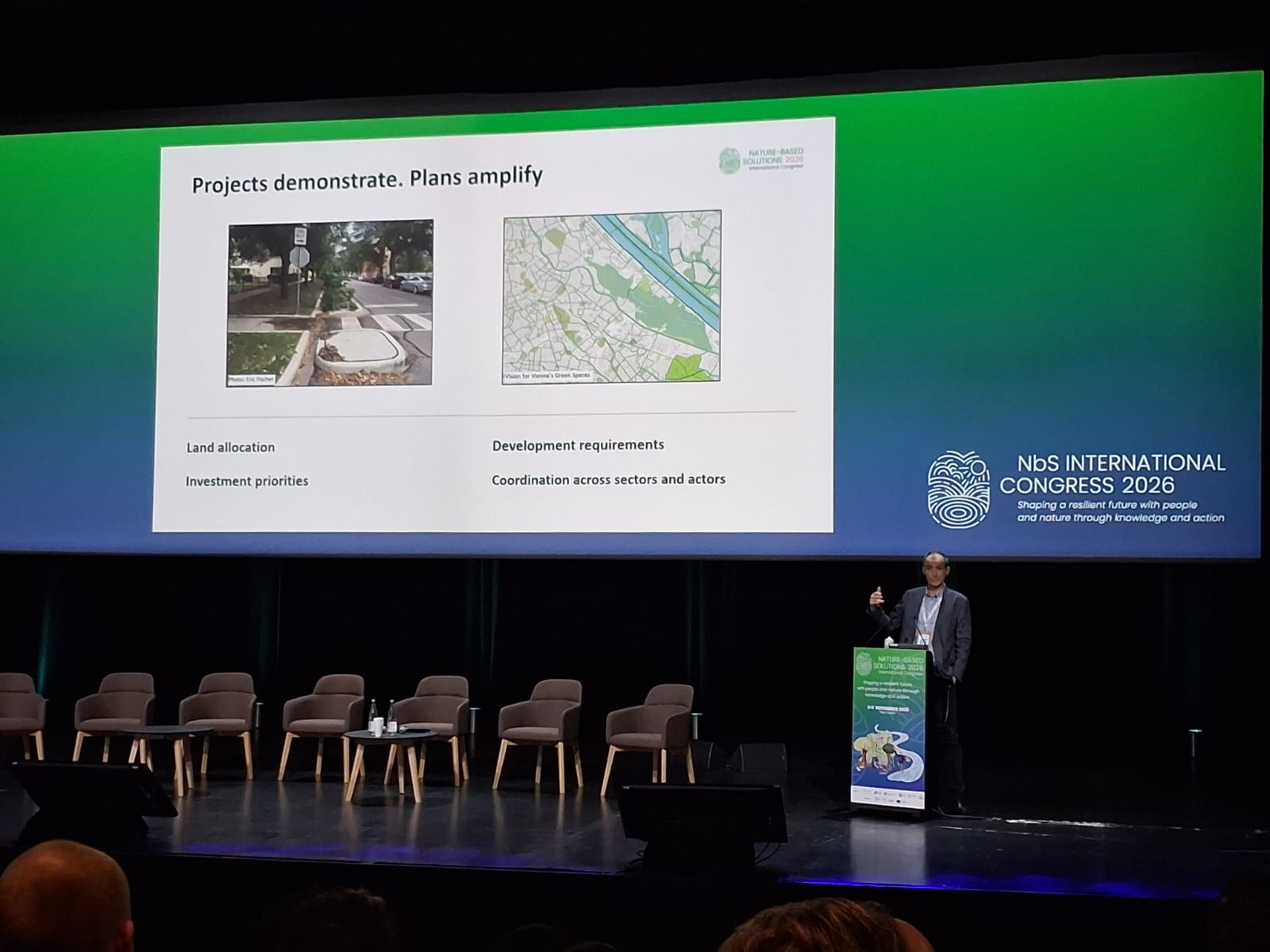
Against a background of environmental crises that are actively altering the course of life on Earth, the five-day agenda centred around meaningful exchange of expertise and actionable knowledge. BioAgora consortium member Davide Geneletti (University of Trento) contributed to these proceedings with a keynote speech entitled "Planning urban Nature-based Solutions across space, over time and below the surface". In that sense, his input focused on how urban planning can support the combined and lasting performance of NbS in the context of three concrete dimensions.
"Across space" being the first among them, he stressed that it involves a focus shift from individual projects to a coordinated urban portfolio encompassing ecosystem protection, restoration and new interventions. Different NbS can thus contribute complementary functions, while their spatial configuration and interactions shape the overall performance. With this in mind, he cited evidence from urban flood management to illustrate why priorities depend on functional relationships across the city. Overall, he stressed that delivery requires instruments suited to ownership and development realities.
"Over time" being the dimension to follow, Geneletti explained that a planned portfolio becomes operational through implementation and ecological establishment at different rates. Subsequently, benefits may emerge rapidly, increase through maturation or decline, depending on ecological processes and continued management. In his view, planning therefore needs to connect ecological trajectories with funding availability, political cycles and owners’ uptake. Citizens’ and stakeholders’ preferences add another dimension accounted for by him, highlighting the importance of understanding expectations about when benefits become available.
Finally turning to matters "below the surface", the keynote specified that NbS generally depend on entire urban ecosystems, including soils and their biodiversity, carbon stocks and hydrological properties. On that note, it also highlighted how similar vegetation cover can conceal different soil conditions and connections. In that sense, green-area targets alone were pointed out to provide an incomplete basis for assessing benefits, particularly where underground structures alter soil depth and connections.
Ultimately, Geneletti's central argument coalesced around the notion that amplifying NbS requires securing the conditions behind their performance. He stated that planning should coordinate the portfolio as a system, anticipate changing benefits and incorporate soil conditions into development requirements and benefit assessments.
These observations and conclusions strongly relate to the work being undertaken within the NbS Knowledge Exchange Network (KEN) that was developed by BioAgora as a mechanism for tying nature and governmental practice together. A testament to this is the handbook of tools for informing and monitoring urban greening strategies and nature plans, developed in response to a knowledge request by the European Commission. Like the other Networks of its kind, the NbS KEN thus forms part of the Science Service for Biodiversity (SSBD), a framework for EU-level science-policy dialogues that has been at the heart of BioAgora's efforts since the project's onset.
More information about the NbS KEN can be accessed here. The full aforementioned handbook on urban greening and its associated planning tools is available via this link.